

1 ml ampoule:
৳ 362.00
(1 x 5: ৳ 1,810.00)
Also available as:
Indications
Acromegaly: Sandostatin Injection is indicated to reduce blood levels of growth hormone (GH) and insulin growth factor-1 (IGF-1; somatomedin C) in acromegaly patients who have had inadequate response to or cannot be treated with surgical resection, pituitary irradiation, and bromocriptine mesylate at maximally tolerated doses.
Carcinoid Tumors: Sandostatin Injection is indicated for treatment of severe diarrhea and flushing episodes associated with metastatic carcinoid tumors.
Vasoactive Intestinal Peptide Tumors: Sandostatin Injection is indicated for the treatment of the profuse watery diarrhea associated with vasoactive intestinal peptide tumors (VIPomas)-secreting tumors.
Carcinoid Tumors: Sandostatin Injection is indicated for treatment of severe diarrhea and flushing episodes associated with metastatic carcinoid tumors.
Vasoactive Intestinal Peptide Tumors: Sandostatin Injection is indicated for the treatment of the profuse watery diarrhea associated with vasoactive intestinal peptide tumors (VIPomas)-secreting tumors.
Pharmacology
Sandostatin Injection exerts pharmacologic actions similar to the natural hormone, somatostatin. It is an even more potent inhibitor of GH, glucagon, and insulin than somatostatin. Like somatostatin, it also suppresses luteinizing hormone (LH) response to gonadotropin releasing hormone (GnRH), decreases splanchnic blood flow, and inhibits release of serotonin, gastrin, VIP, secretin, motilin, and pancreatic polypeptide. By virtue of these pharmacological actions, octreotide has been used to treat the symptoms associated with metastatic carcinoid tumors (flushing and diarrhea), and VIP secreting adenomas (watery diarrhea).
Octreotide substantially reduces GH and/or IGF-1 (somatomedin C) levels in patients with acromegaly. Single doses of octreotide have been shown to inhibit gallbladder contractility and to decrease bile secretion in normal volunteers. In controlled clinical trials, the incidence of gallstone or biliary sludge formation was markedly increased
Octreotide substantially reduces GH and/or IGF-1 (somatomedin C) levels in patients with acromegaly. Single doses of octreotide have been shown to inhibit gallbladder contractility and to decrease bile secretion in normal volunteers. In controlled clinical trials, the incidence of gallstone or biliary sludge formation was markedly increased
Dosage & Administration
Octreotide Acetate Injection may be administered subcutaneously or intravenously.
Acromegaly: Recommended initial Octreotide acetate dosage is 50 mcg three times daily during the initial 2 weeks of therapy. Maintenance dose 100 mcg to 500 mcg three times daily.
Carcinoid Tumors: Recommended dosage range of 100 mcg to 600 mcg daily in two to four divided doses during the initial 2 weeks of therapy.
VIPomas: Recommended dosage range of 200 mcg to 300 mcg daily in two to four divided doses during the initial 2 weeks of therapy.
Pediatric Use: Safety and efficacy of Octreotide Acetate Injection in the pediatric population have not been demonstrated.
Acromegaly: Recommended initial Octreotide acetate dosage is 50 mcg three times daily during the initial 2 weeks of therapy. Maintenance dose 100 mcg to 500 mcg three times daily.
Carcinoid Tumors: Recommended dosage range of 100 mcg to 600 mcg daily in two to four divided doses during the initial 2 weeks of therapy.
VIPomas: Recommended dosage range of 200 mcg to 300 mcg daily in two to four divided doses during the initial 2 weeks of therapy.
Pediatric Use: Safety and efficacy of Octreotide Acetate Injection in the pediatric population have not been demonstrated.
Interaction
Cyclosporine: Sandostatin has been associated with alterations in nutrient absorption, so it may have an effect on absorption of orally administered drugs. Concomitant administration of Sandostatin Injection with cyclosporine may decrease blood levels of cyclosporine and result in transplant rejection.
Insulin and Oral Hypoglycemic Drugs: Sandostatin inhibits the secretion of insulin and glucagon. Therefore, blood glucose levels should be monitored when Sandostatin Injection treatment is initiated or when the dose is altered and anti-diabetic treatment should be adjusted accordingly.
Bromocriptine: Concomitant administration of octreotide and bromocriptine increases the availability of bromocriptine.
Other Concomitant Drug Therapy: Concomitant administration of bradycardia-inducing drugs (e.g., beta-blockers) may have an additive effect on the reduction of heart rate associated with octreotide. Dose adjustments of concomitant medication may be necessary. Sandostatin has been associated with alterations in nutrient absorption, so it may have an effect on absorption of orally administered drugs.
Drug Metabolism Interactions: Limited published data indicate that somatostatin analogs might decrease the metabolic clearance of compounds known to be metabolized by cytochrome P450 enzymes, which may be due to the suppression of GH. Since it cannot be excluded that octreotide may have this effect, other drugs mainly metabolized by CYP3A4 and which have a low therapeutic index (e.g., quinidine, terfenadine) should therefore be used with caution.
Lutetium Lu 177 Dotatate Injection: Sandostatin competitively binds to somatostatin receptors and may interfere with the efficacy of lutetium Lu 177 dotatate. Discontinue Sandostatin Injection at least 24 hours prior to each lutetium Lu 177 dotatate dose.
Insulin and Oral Hypoglycemic Drugs: Sandostatin inhibits the secretion of insulin and glucagon. Therefore, blood glucose levels should be monitored when Sandostatin Injection treatment is initiated or when the dose is altered and anti-diabetic treatment should be adjusted accordingly.
Bromocriptine: Concomitant administration of octreotide and bromocriptine increases the availability of bromocriptine.
Other Concomitant Drug Therapy: Concomitant administration of bradycardia-inducing drugs (e.g., beta-blockers) may have an additive effect on the reduction of heart rate associated with octreotide. Dose adjustments of concomitant medication may be necessary. Sandostatin has been associated with alterations in nutrient absorption, so it may have an effect on absorption of orally administered drugs.
Drug Metabolism Interactions: Limited published data indicate that somatostatin analogs might decrease the metabolic clearance of compounds known to be metabolized by cytochrome P450 enzymes, which may be due to the suppression of GH. Since it cannot be excluded that octreotide may have this effect, other drugs mainly metabolized by CYP3A4 and which have a low therapeutic index (e.g., quinidine, terfenadine) should therefore be used with caution.
Lutetium Lu 177 Dotatate Injection: Sandostatin competitively binds to somatostatin receptors and may interfere with the efficacy of lutetium Lu 177 dotatate. Discontinue Sandostatin Injection at least 24 hours prior to each lutetium Lu 177 dotatate dose.
Contraindications
Sensitivity to this drug or any of its components.
Side Effects
Most common adverse reactions (incidence >10%) in patients with acromegaly are gallbladder abnormalities, sinus bradycardia, diarrhea, loose stools, nausea, abdominal discomfort, hyperglycemia, and hypothyroidism. In other patients, most common adverse reactions (incidence >10%) are gallbladder abnormalities.
Pregnancy & Lactation
The limited data with Sandostatin Injection in pregnant women are insufficient to inform a drug-associated risk for major birth defects and miscarriage. In animal reproduction studies, no adverse developmental-effects were observed with IV administration of octreotide to pregnant rats and rabbits during organogenesis at doses 7- and 13-times, respectively the maximum recommended human dose (MRHD) of 1.5 mg/day based on body surface area (BSA). Transient growth retardation, with no impact on postnatal development, was observed in rat offspring from a pre- and post-natal study of octreotide at IV doses below the MRHD based on BSA.
There is no information available on the presence of Sandostatin Injection in human milk, the effects of the drug on the breastfed infant, or the effects of the drug on milk production. Studies show that octreotide administered subcutaneously passes into the milk of lactating rats; however, due to species-specific differences in lactation physiology, animal data may not reliably predict drug levels in human milk. The developmental and health benefits of breastfeeding should be considered along with the mother’s clinical need for Sandostatin Injection, and any potential adverse effects on the breastfed child from Sandostatin Injection or from the underlying maternal condition.
There is no information available on the presence of Sandostatin Injection in human milk, the effects of the drug on the breastfed infant, or the effects of the drug on milk production. Studies show that octreotide administered subcutaneously passes into the milk of lactating rats; however, due to species-specific differences in lactation physiology, animal data may not reliably predict drug levels in human milk. The developmental and health benefits of breastfeeding should be considered along with the mother’s clinical need for Sandostatin Injection, and any potential adverse effects on the breastfed child from Sandostatin Injection or from the underlying maternal condition.
Precautions & Warnings
Cardiac Function Abnormalities: Increased risk for higher degree of atrioventricular blocks. Consider cardiac monitoring in patients
receiving Sandostatin Injection intravenously. Bradycardia, arrhythmias, or conduction abnormalities may occur. Use with caution in at-risk patients. Dosage adjustment of cardiac medications may be necessary.
Cholelithiasis and Complications of Cholelithiasis: Monitor periodically. Discontinue if complications of cholelithiasis are suspected.
Glucose Metabolism: Hypoglycemia or hyperglycemia may occur. Glucose monitoring is recommended and anti-diabetic treatment may need adjustment.
Thyroid Function: Hypothyroidism may occur. Monitor thyroid levels periodically.
Steatorrhea and Malabsorption of Dietary Fats: New onset steatorrhea, stool discoloration, loose stools, abdominal bloating, and weight loss may occur. If new occurrence or worsening of these symptoms are reported, evaluate for potential pancreatic exocrine insufficiency.
receiving Sandostatin Injection intravenously. Bradycardia, arrhythmias, or conduction abnormalities may occur. Use with caution in at-risk patients. Dosage adjustment of cardiac medications may be necessary.
Cholelithiasis and Complications of Cholelithiasis: Monitor periodically. Discontinue if complications of cholelithiasis are suspected.
Glucose Metabolism: Hypoglycemia or hyperglycemia may occur. Glucose monitoring is recommended and anti-diabetic treatment may need adjustment.
Thyroid Function: Hypothyroidism may occur. Monitor thyroid levels periodically.
Steatorrhea and Malabsorption of Dietary Fats: New onset steatorrhea, stool discoloration, loose stools, abdominal bloating, and weight loss may occur. If new occurrence or worsening of these symptoms are reported, evaluate for potential pancreatic exocrine insufficiency.
Therapeutic Class
Growth hormone antagonist
Storage Conditions
Store at 2-8° C. Stable at room temperature for up to 14 days.
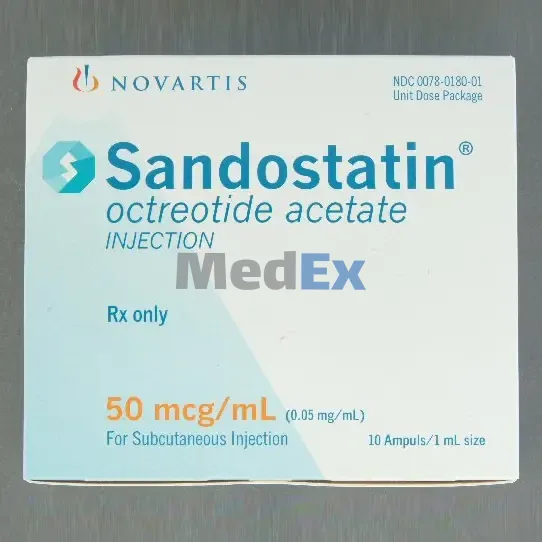 Pack Image: Sandostatin 50 mcg/ml Injection